Depending on who you ask, the words “content strategy” may conjure up thoughts of editorial calendars and blog posts. For others, the phrase brings to mind a practice rooted in planning, governance, and purposeful management across an organization. Whatever the term evokes for you, when you’re serious about search visibility, qualified leads, and a competitive advantage, a content strategy is no longer optional; it’s the foundation of predictable, measurable business growth.
We’ve spent over two decades helping brands evolve how they think about content and search. What we’ve learned consistently is this:
Content without strategy is noise.
We’ve seen this pattern repeatedly across industries. It’s common to find organizations publishing at volume but struggling to connect content performance to pipeline growth. The gap is rarely effort; it’s almost always strategic alignment.
In this article, we’ll help you understand content strategy through the lens of our modern search landscape – not as a publishing checklist, but as a strategic capability that makes your entire SEO engine more robust.
Table of contents
- Strategy first, and why data matters at every step
- Content strategy turns planning into strategic SEO enablement
- Common Content Strategy Mistakes That Hurt Growth
- A Strategic Content Framework That Drives Leads
- The Outcome of a Strategic Content + SEO System
- Next Step: Elevate Your Content Strategy With Strategic SEO Leadership
Strategy first, and why data matters at every step
Strategy, campaigns, and tactics are words that are often used interchangeably, but treating them as such is how many teams end up being busy without being effective. To build a content strategy in a way that fuels strategic SEO and lead growth, you need a clear hierarchy. Logic gives that to us.
Strategy feeds the campaign. The campaign feeds tactics. And data runs through it all.
This hierarchy is deliberate and makes sure your content efforts are grounded in business outcomes instead of simply “getting things done.”
Strategy defines the why and what
Strategy without data is just opinion. Data without a strategy is just noise.
Strategy answers the hard questions. Who are you trying to influence? What outcomes are we most interested in? What priorities should we use as a guide?
This is where data enters the picture first and most significantly. Strategic decisions should never be made on intuition (e.g., “gut feelings”) alone. They should always be informed by measurable audience behavior (such as engagement rates), search intent signals (whether it’s an informational, transactional, or commercial intent search), competitive performance (what are they doing), and historical performance trends (what have we done in the past that succeeded?).
Campaigns translate strategy into action plans
Campaigns are data-informed plans, not guesses.
Once your strategic priorities are set, you’re ready to design the campaigns to reach your goals. Campaigns exist to execute defined strategic priorities within a controlled timeframe.
- They allocate resources.
- They sequence effort.
- They establish benchmarks.
- They concentrate focus.
Here, data helps you choose the target audience, based on your goals. You’ll understand which channels or formats have historically shown traction for your company. That performance history can help you set realistic expectations now. And all of it can help you determine how best to sequence activities for the best impact.
Tactics bring campaigns to life and optimize execution
Tactics are the boots-on-the-ground tools to reach your goals.
Tactics include choosing which platforms you’ll use for your campaign and which type (s) of content you’ll create. They also include scheduling (your editorial calendar) and the calls to action that drive your goals.
At this tactical level, data plays an optimizing role:
- A/B testing improves conversion rates
- Engagement metrics shape content refinement
- Search performance guides prioritization
A tactic without data feedback is like driving blind. The real advantage comes when you build feedback loops that feed results back into your strategy.
Data is the glue, not an add-on
Data should be something that is built into your strategy process from the beginning. According to Invoca, 87% of marketers say data is their company’s most under-utilized asset. By integrating data layers throughout your strategy, you are creating a true competitive advantage. The infographic below shows how the feedback loop should work.
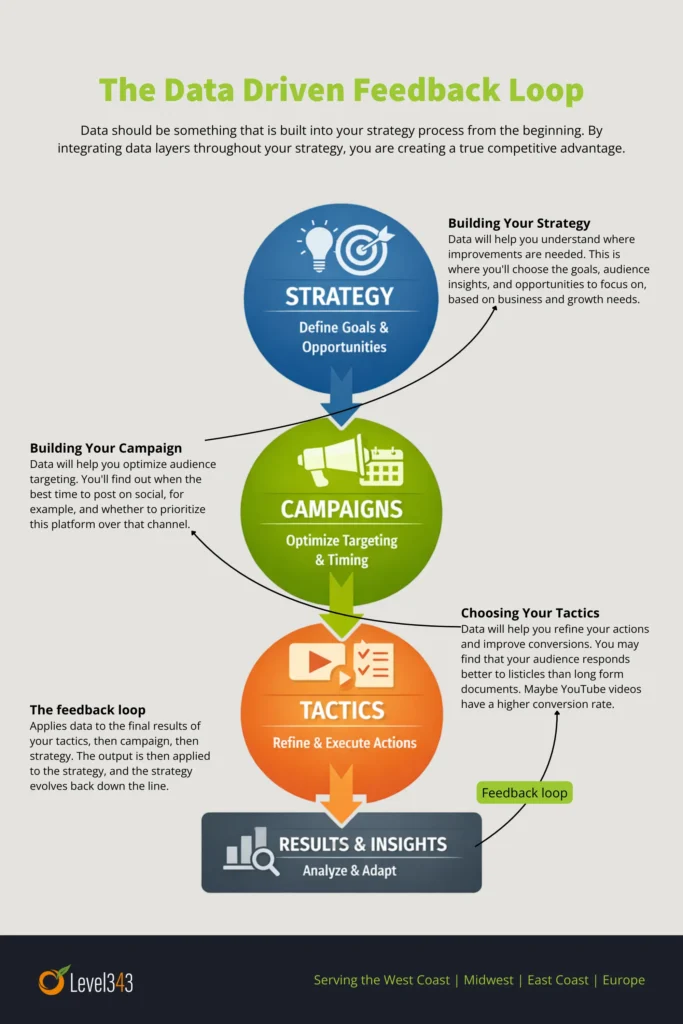
The feedback loop applies data to the final results of your tactics, then campaign, then strategy. The output is then applied to the strategy, and the strategy evolves back down the line. This model ensures your strategic decisions are continuously refined by measurable outcomes, which is the strategic SEO practice we advocate.
Content strategy turns planning into strategic SEO enablement
Strategic SEO depends on content strategy. One cannot scale without the other.
Small and large teams often equate content strategy with what to write next. As if answering “what comes next” is the goal.
However, this is a limiting tactical view. A robust content strategy should answer deeper, business-critical questions, like “who are we trying to influence,” and “what are we hoping to accomplish with this piece/campaign/strategy?”
Here’s how the two intersect in a way that actually drives measurable outcomes.
Audience & Intent Mapping Become Conversion Blueprints
Traditional content strategies focus on personas and topics. Modern content strategies link audience intent to search behavior and then to business outcomes like leads and pipeline value. Search engines increasingly reward content that demonstrates clear topical authority and real-world experience that matches user intent.
Modern content strategies include mapping keyword and intent clusters to buyer journeys. It means creating topic flows that move audiences through the pipeline from discovery to conversion. It also includes designing measurement frameworks that go beyond pageviews.
In strategic SEO, you don’t guess what content matters. You know, because it’s tied to demonstrated intent and business impact.
Information Architecture Influences Decisions
Content strategy today should be cohesive and hierarchical. This is where the intersection with SEO becomes powerful. Topical authority builds visibility, while internal linking builds context. The content hierarchy should guide users toward conversion actions.
Without a strong information architecture, which is how the information on your site is laid out, even great content can get lost. With it, every piece of content becomes a deliberate step in the journey from awareness to decision.
Content Governance Keeps Strategy Alive
Many content strategies die after launch because no one owns them. A robust content strategy has a lot of moving parts, sometimes dozens. It’s extremely important to have clear roles and ownership.
The process flow of ideation, creation, review, and optimization also must be managed. Someone needs to be responsible for the smooth transition from one step to the next. Someone also needs to be available to ensure the feedback loops are tied to performance data rather than gut work and instinct. Finally, all of that should be kept aligned with broader marketing and SEO goals.
This can feel like operational busywork, but it’s not. Strategic discipline is what makes content strategy operationally effective and sustainable.
Performance Measurement is Business Measurement
One of the biggest mistakes brands make is tracking the wrong metrics. In one instance, we were handed a sheet of KPIs that literally had nothing to do with anything but traffic. The dashboard celebrated traffic while the pipeline was stagnating. Where that traffic went and what they did on the site was a huge blind spot.
Visibility without impact is not performance. Views and keyword rankings are nice to have, but they aren’t business outcomes. We emphasize frameworks where:
- Content performance is tied to lead quality
- Engagement behavior influences CRM segmentation
- Search visibility contributes to pipeline velocity
At this point, your content strategy takes the biggest leap away from creating publishing schedules to developing an accountability engine.
Common Content Strategy Mistakes That Hurt Growth
Even seasoned teams fall into familiar traps:
- Publishing without intent: Content creation because it’s “scheduled,” not because it moves the business forward.
- Treating SEO and content as separate: Content and search need to be tightly connected from research to execution to measurement.
- Ignoring audience shifts: The way people search and consume content changes rapidly, and strategy must adapt.
- Not operationalizing insights: Data without action is noise.
Fixing these issues is not a tactical exercise. It requires strategic alignment. Which leads us to how you should build your strategy.
A Strategic Content Framework That Drives Leads
Most teams understand pieces of this process. Few integrate all of it consistently, and integration is where competitive advantage lives. Here’s a high-level content strategy framework that aligns with strategic SEO principles and lead outcomes:
Start with Intent, Not Topics
Instead of “what should we write about,” start with “what is our audience trying to accomplish?” In your data, you should see the terms that are bringing people to your site. Auditing those terms will help you better understand what they’re looking for.
Categorizing your search queries into informational, commercial, and transactional will help you further understand where high-intent traffic overlaps with business priorities (How much does SEO cost? When does SEO ROI kick in?).
Build Topic Authority That Maps to Business Outcomes
Authority isn’t created through 100 random blog posts. Here, you’ll group related problems and solutions into clusters that reflect decision journeys.
You do this by identifying 3-5 core topic pillars that align with your service and/or revenue drivers. Cluster your supporting content around each pillar:
- Educational (problem awareness)
- Comparative (solution evaluation)
- Decision-stage (conversion support)
Tie each cluster into a measurable outcome, such as leads, demo requests, bookings, and MQL (marketing qualified lead) generation.
Create Aligned Processes
Define the steps and ownership for how ideas become briefs, briefs become content, and content becomes optimized assets tied to goals. In other words, create a standard for content briefs that connects them to search intent, target personas, conversion objectives, and primary/supporting key terms.
Use Data to Guide Optimization
Measuring the effectiveness of your tactics, campaigns, and strategies is a matter of measuring your business, not just traffic. How does your content contribute to the pipeline? This is your bottom-line thinking.
An important first step is to define primary KPIs before publishing anything. Is it lead form completions? Assisted conversions? With this information, you can then choose your behavioral metrics, such as CTA click rates, scroll depth, and time on page.
Then, deploy the feedback loop of performance data back through the system for optimization and improvement. This should be systematic, not reactive.
Connect Content Systems to Strategic SEO Practices
Content can’t operate in a silo parallel to SEO. It has to be hand-in-hand. This is how your content that you work so hard on gets found, earned, and converted. We’re not talking about more content; we’re talking about better content, built with purpose, optimized for visibility and conversion.
You can do this by aligning your content pillars with keyword clusters and search opportunity gaps. If you’re ranking #1 for lower fruit yet targeted keywords, for example, you now have the opportunity to start moving to higher competition terms.
You support your efforts with tactics such as technical SEO (schema markup, page speed, UX improvements, etc.). You improve your content performance by using data to prioritize future content, and then tie SEO reporting into pipeline reporting. Make it clear to leadership that neither is standalone.
The Outcome of a Strategic Content + SEO System
When content strategy is built this way, you see outcomes like:
- Higher qualified lead velocity
- Clearer attribution from search to pipeline
- Consistent thematic authority in your space
- Internal teams that make faster, higher-quality decisions
- A scalable content ecosystem that evolves with the market
These aren’t theoretical benefits. We’ve seen them firsthand in engagements spanning industries and competitive landscapes.
During the pandemic, when many medical training facilities were closing, one of our clients saw an 18% enrollment increase within six months. Within two years, that growth reached 42%. The driver was the strategic alignment between their business goals of filling seats and the demonstrated user intent of needing recertification.
When strategy, governance, and SEO operate as a single system, performance becomes predictable. That predictability is the difference between reactive marketing and strategic growth leadership.
Next Step: Elevate Your Content Strategy With Strategic SEO Leadership
Strategic content isn’t nice to have. It’s the backbone of modern SEO and growth. If your content planning feels tactical, inconsistent, or disconnected from business outcomes, it’s time to close the gap.
We help in-house teams transform content strategy into a strategic capability that feeds search visibility, drives qualified pipeline, and strengthens business outcomes.