CONTENT MARKETING AND STRATEGY

Build content that actually does the work you need it to

Learn how to diagnose problems, define direction, and build content that supports authority, relevance, and business growth.

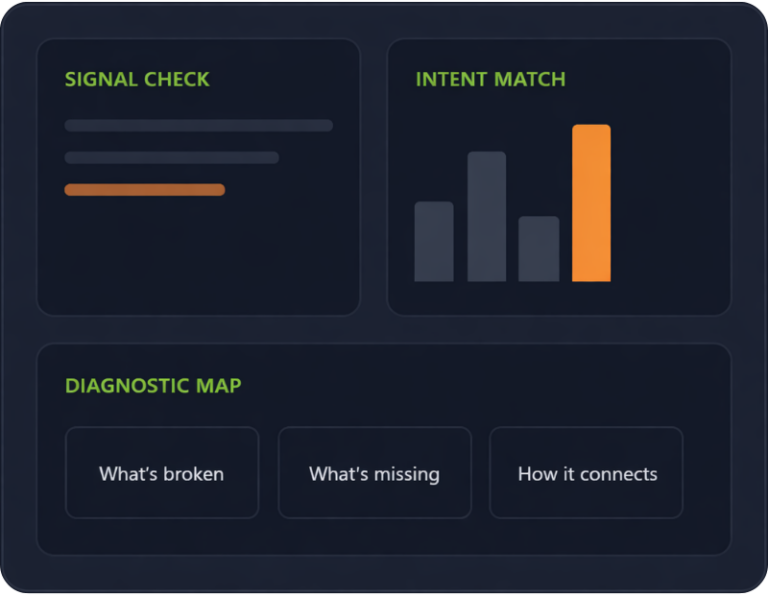
content optimization dashboard mockup

Build the system that makes content strategy work

Many clients come to us asking for a content marketing strategy because they want better results from the effort they’re already putting in. Strategy matters, but rarely fixes content problems on its own.

The time is long gone when writing content for the sake of content was a good marketing strategy. Content works best when it’s part of a larger system. When it’s created as a “piece” instead of part of the whole, it loses connection to your site, your existing content, and your target audience.

A content marketing system gives structure to every stage of the work. It answers “What comes next?” and just as importantly, “Why are we doing this?” Before anyone starts writing, the team should already understand the goal of the piece, how it supports the business, who it’s for, what problem it addresses, and where it fits in the larger content picture.

Content doesn’t fail because of one obvious mistake. It fails when structure, intent, authority, and execution don’t line up. This guide breaks content marketing into clear stages so you can diagnose what’s happening, make better decisions, and improve the right things in the right order.

Content Diagnostics

  • Signal check
  • Intent match
  • Diagnostic map

Go to section

Content Strategy

  • Audience
  • Intent
  • Positioning

Go to section

Content Planning

  • Topics
  • Clusters
  • Priorities

Go to section

Content development

  • Structure
  • Clarity
  • Usefulness

Go to section

Content optimization

  • On-page
  • Intent
  • Refinement

Go to section

Conversion performance

  • Outcomes
  • Behavior
  • Conversion

Go to section

Diagnose your Content

Why isn’t your content working?

Before you create more content, you need to understand what’s actually happening across your site. Most content issues aren’t obvious. They come from gaps in structure, mismatched intent, or content that exists but isn’t doing its job.

The Diagnose stage helps you step back and evaluate your content as a system. You’re not just looking at individual pages; you’re looking at how everything connects, performs, and supports your growth goals. 

Start here

Identify what exists, how it’s performing, and where things begin to break down.

Build a content inventory

A content inventory gives you a complete view of what you have. Once you’ve found your hidden, outdated, or disconnected content, you can understand how your site is structured rather than how you think it is.

Conduct a content audit

A content audit goes deeper, evaluating how each piece performs and where it falls short. It helps you identify weak pages, missed opportunities, and structural issues that are limiting your results.

Create a gap analysis

A gap analysis connects everything. It shows what’s missing, where coverage is uneven, and what needs to be created or improved for your content system to work as a whole.

Define your strategy

How do you build a content strategy that works?

Once you understand what’s happening in your content, the next step is deciding what it should actually do. A content strategy isn’t a list of topics or a publishing schedule; it’s the system that connects your audience, business goals, and content decisions.

This is where you define how content supports the business. You align audience needs, search intent, funnel stage, and page purpose so each piece of content has a clear role instead of competing for attention. Strategy answers the hard questions: who you’re trying to reach, what they need, and how your content moves them forward.

Step Two

Define who your content is for and what each piece is meant to accomplish.

Build a content strategy that holds everything together

A strong content strategy acts as the master plan for your marketing, guiding how your business communicates and grows over time. It brings together your goals, audience, and execution into a structure you can actually follow.

Create a content marketing mix that supports real goals

Your content shouldn’t all do the same job. A content marketing mix helps you balance formats, topics, and funnel stages so your content works together instead of overlapping or competing.

Use buyer personas to guide your content decisions

Content performs better when it’s built for real people, not assumptions. Buyer personas help you understand your audience’s needs, motivations, and decision paths so your content connects and converts more effectively.

Plan your content

What content should you create, and how does it fit together?

With direction in place, the next step is deciding what content needs to be created and how it fits together. This is where you turn direction into structure, mapping topics to intent, assigning priorities and purpose to each piece, and sequencing so your content works together instead of competing.

A content plan isn’t just a calendar. It’s the layer that connects your strategy to execution, defining what gets created, when, and how each piece supports the bigger picture. Without it, content becomes reactive and inconsistent instead of intentional and cumulative. 

Step Three

Decide what content to create, how often to publish, and how each piece supports your system.

Plan your content to support growth goals

Content planning connects your strategy to execution by organizing topics, priorities, and purpose. It ensures each piece contributes to a larger system instead of standing alone.

Decide what to create, where, and how often

A strong content plan answers practical questions like what to publish, where it belongs, and how frequently it should go live. This helps you stay consistent while aligning with audience behavior and platform expectations.

Create content briefs that guide better execution

A content brief defines what a piece needs to accomplish before writing begins. It clarifies audience, intent, and structure so content is consistent and aligned from the start.

Develop your content

How do you create content that performs?

A plan only works if it’s executed well. This is where content development comes in. Planning tells you what to create; development is where that plan goes into action.

Creating content isn’t just writing. It’s a structured process that combines research, audience understanding, messaging, and execution. Strong content development ensures each piece is built with purpose, in line with strategy, and designed to engage the right audience from the start. When development is done well, content connects, builds trust, and moves people toward action.

Step Four

Build content that matches your audience, purpose, and the role it needs to play.

Build content that matches your strategy

Content development connects strategy to execution by defining what each piece needs to say and how it fits into a larger system. It makes sure your content works together instead of existing as isolated pieces.

Write copy that connects and converts

Content development builds the structure, but copywriting drives action. Strong copy helps your message resonate, guide the reader, and turn engagement into meaningful results.

Use headlines to capture attention and lead the reader

Headlines shape how content is experienced before it’s even read. Strong headline structures help draw attention, set expectations, and improve engagement across every piece of content.

Optimize your content

How do you improve content for lasting performance?

Once content is created, the next step is improving how it performs. Content optimization helps content be more useful, visible, and effective over time. It focuses on how your content is written, structured, and presented so both users and search engines can understand it clearly. Even small improvements like better structure, clearer messaging, and stronger alignment with intent can improve engagement, readability, and overall performance.

Optimization isn’t a shortcut to rankings. It’s how you make content more relevant, more valuable, and easier to connect across your site. When content is optimized well, it improves visibility, strengthens authority, and supports better user interaction. Not by forcing keywords, but by focusing on quality and usefulness.

Step Five

Improve how your content is structured, connected, and in line with intent.

Optimize content for clarity, relevance, and engagement

Content optimization improves how your content performs by focusing on usefulness, structure, and relevance. It ensures your content answers real questions, engages your audience, and supports long-term visibility instead of relying on outdated tactics.

Strengthen your content so it delivers more value

Optimized content builds stronger relationships with your audience by improving quality, clarity, and usefulness. It helps your content do more, supporting engagement, brand recognition, and long-term growth.

Add depth and value to existing content

Adding depth, clarity, and supporting information helps content better serve its purpose. This process strengthens what already exists, so it performs more effectively within your overall content system.

Improve conversion and performance

How does your content turn attention into action?

Stronger content should lead to better outcomes. This is where performance becomes measurable.

Getting traffic is only part of the work. What matters is what people do after they land on your page. Conversion doesn’t happen in a single step. It’s a series of actions: clicking, reading, engaging, and deciding what to do next. Each of those steps is a point where users either move forward or drop off.

Improving performance means understanding where those breakdowns happen and why. When your content fits intent, supports the user’s next step, and removes friction, it becomes easier for people to take action.

Step Six

Identify what actions you want users to take and where they’re dropping off.

Build landing pages that support real decisions

A landing page is part of a larger conversion path, not a standalone asset. When content, intent, and expectations don’t align, users leave before taking action.

Improve how your content converts readers into action

Conversion optimization focuses on how content and design influence behavior. Understanding your audience, their journey, and their decision points helps turn engagement into measurable results.

Connect content with user intent to improve results

Conversion performance depends on how well your content matches what users are trying to do. When intent and experience match, it becomes easier for users to move forward and complete the next step.

Content improves when you stop treating it like a series of pages

Content creation without purpose is just writing. It can be iterative, but it isn’t sustainable. A content system, on the other hand, gives structure to what you’re creating, why you’re creating it, and how it fits into the bigger picture.

Each stage builds on the last. Diagnosing your content shows you what’s actually happening. Strategy defines what it should do. Planning turns that direction into structure. Development brings it to life. Optimization strengthens it. And performance shows you what’s working and what isn’t.

When structure, intent, and execution are aligned, it becomes clear what to fix, what to create, and what to improve next. That’s what turns content into something that consistently supports results.

Need help sorting it out?

If your content isn’t performing the way it should, there’s a reason.

We’ll help you connect the pieces, fix what’s broken, and move things forward. Start building your content system.

Hello there! Please read to understand how we handle your privacy.

This website uses tracking cookies to help us understand how you use the site and improve upon your experience. We do not share any information collected – either personal or anonymous – with any other parties, with the exception of the reporting programs we use in conjunction with those cookies. By continuing to use this site, you agree to the use of these cookies. If you do not agree, please close the site.