This might be hard to believe, but an old page can still be doing real work for you. It might hold onto rankings for a handful of useful queries, carry a couple of backlinks you’d hate to lose, or explain something clearly enough that people still find it years later. Old doesn’t automatically mean bad. And underperforming doesn’t automatically mean “delete it and start over.”
It also doesn’t mean leave it alone by default. Facts go stale, prices change, screenshots stop matching the product, and the reader who lands on the page today isn’t always trying to make the same decision as the reader who landed on it three years ago. Somewhere between “never touch it” and “rewrite the whole thing,” there’s a smarter move: figure out what’s actually wrong, then fix that.
This guide walks through that process: diagnose the page, decide what kind of update it needs (if any), preserve what’s already working, update what isn’t, reconnect it to the rest of your site, and measure whether it helped. Six steps, in that order, because doing them out of order is how good pages get worse.
Know what a content update actually is
A strong content update improves an existing page based on evidence. It might correct something, expand it, restructure it, merge it with another page, reformat it, or reconnect it to the rest of your site with better links. That’s a specific kind of work, and it’s worth separating from a few things people often lump in with it.
It’s not routine proofreading. Fixing a typo isn’t a content update; it’s basic maintenance. It’s not just changing the publish date, either. Bumping a timestamp without doing the underlying work fools nobody, least of all your readers. It’s also not automatically rewriting everything from scratch. Most pages that need help need targeted fixes, not a demolition. And it’s not the same as the full content-optimization process covered in How to Optimize Content for Search Visibility, which is the broader workflow this article’s decisions feed into.
Look for real refresh triggers
Before you touch anything, make sure there’s an actual reason to. Here are the signs worth taking seriously:
- Facts, statistics, laws, prices, products, screenshots, tools, or examples have changed.
- Qualified impressions, clicks, conversions, or engagement have declined over a meaningful period, not just a slow week.
- The search results or the dominant intent for the topic have shifted since you published.
- The page ranks fine but earns few clicks, because the promise in the title no longer matches what people actually want.
- Links, media, offers, forms, or CTAs on the page are broken or pointing at something that no longer exists.
- The content is redundant, outdated, trivial, inaccurate, or unsupported.
- Another page on your site overlaps or competes with it for the same reader decision.
- Your business offering or your audience has changed enough that the page no longer fits either one.
There’s a real difference between a page that’s merely old and a page that’s gone stale. A three-year-old explainer with accurate information and a clean structure is just old; it’s doing fine. A three-year-old page recommending a discontinued tool, citing a law that’s since changed, or promising something your business doesn’t offer anymore has gone stale, whatever its age.
Timeliness and relevance matter, but “it’s been a while” isn’t a trigger on its own. If nothing on that list applies, the right move is to leave it alone.
Build the baseline before you edit
This is the step that gets skipped most often, and skipping it is how updates end up guessing instead of fixing. Before you touch a word, review:
- The page’s role and original purpose. What was it supposed to do?
- GA4 traffic, engagement, and conversion trends over a meaningful window.
- Search Console clicks, impressions, CTR, average position, and the breadth of queries it’s showing up for.
- The current SERP for its target topic. What’s ranking now, and what does that tell you about expected format and depth?
- Incoming internal links and backlinks it currently has.
- Indexability, canonical tag, crawl depth, metadata, mobile rendering, and any relevant structured data.
- Whether it overlaps or cannibalizes another page on your site.
- Which sections, examples, links, or assets are already pulling their weight, so you don’t accidentally cut something that’s working.
For a more structured version of this review, especially when the question extends beyond one page, see Content Audits: How to Understand What Your Content Is Actually Doing.
Choose the right action before rewriting
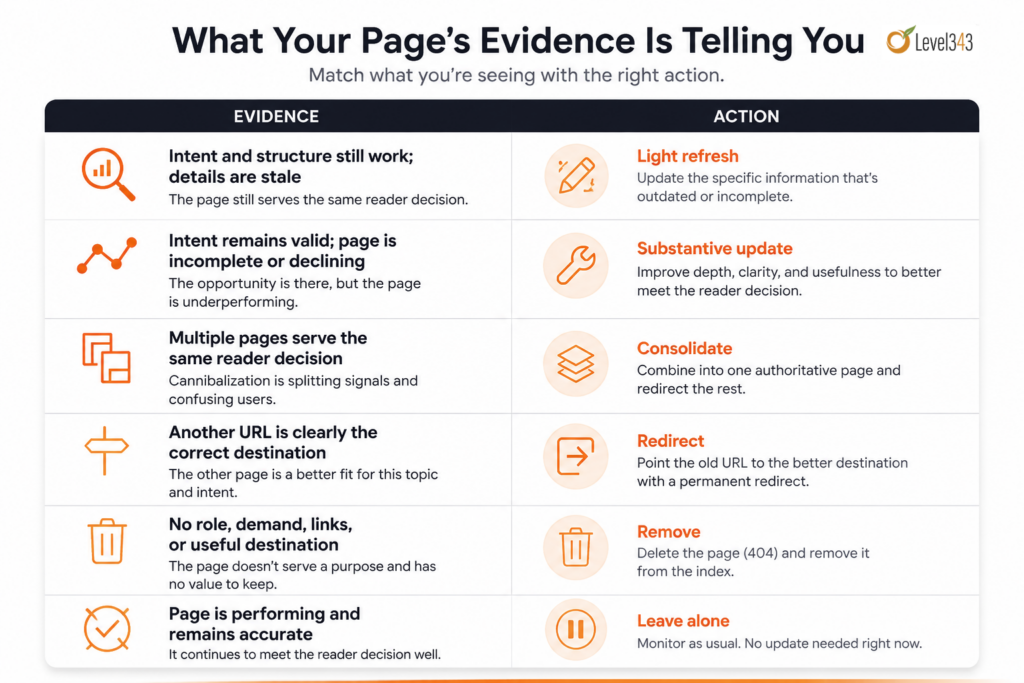
Once you know what’s actually happening, match the response to the evidence instead of defaulting to a full rewrite:
- Light refresh: the facts, links, images, screenshots, examples, metadata, or CTA need correcting, but the structure and intent still work fine.
- Substantive update: the intent is valid, but the page is incomplete, outdated, thin, poorly structured, or steadily losing visibility.
- Consolidate: this page and another one on your site are serving the same reader decision, and neither has a good reason to exist separately.
- Redirect: another URL is now the best destination for this topic, so the old URL should permanently redirect to it and its relevant signals can be consolidated around the surviving page.
- Remove: the page has no real role, no demand, no links, and nowhere useful to send anyone.
- Leave alone: the page is doing its job, or the evidence just isn’t strong enough to justify touching it.
In our experience, many pages flagged for an update need less work than you might initially assume. Reserve a substantive rewrite for pages where the underlying promise to the reader has actually broken down.
Preserve what already works
Preservation isn’t an afterthought here; it’s a deliberate step, and it comes before you start cutting or rewriting.
Keep the existing URL unless the evidence genuinely supports consolidation or migration. An unnecessary URL change introduces avoidable risk, requires redirects and link updates, and can temporarily disrupt the visibility the page has already earned.
Identify the sections, queries, links, examples, and conversion elements that are already performing, and protect them. Retain distinctive original language and first-hand insight anywhere it’s still accurate; a page loses its voice fast when every sentence gets swapped out for something generic. Preserve the backlinks and internal links already pointing at the page, since those took real effort to earn.
And don’t remove useful content just because it’s old. Old content can be genuinely revitalized rather than thrown out, and a lot of it deserves that chance before you decide otherwise. If a redirect or merge does turn out to be the right call, record it before you delete or combine anything, not after.
Remove the ROT, and more
ROT is still the right starting lens: content that’s redundant, outdated, or trivial. It’s worth keeping that acronym and expanding what you look for under it.
Redundant means repeated sections, duplicate pages, or explanations you’ve already made elsewhere on the page or the site. Outdated means stale facts, discontinued tools, obsolete screenshots, dead links, and offers that expired months ago. Trivial means filler that doesn’t help the reader decide or act, the paragraph that exists to hit a word count rather than answer a question. Beyond the original three, also watch for content that’s inaccurate or unsupported (claims you can’t actually back up) and content that’s off-role (material that belongs in a different article and is just diluting this one).
Here’s what that looks like on one paragraph. A generic, redundant, and trivial version might read: “Social media is important for marketing in today’s digital landscape. Businesses should maintain a presence across multiple platforms to stay competitive and reach their target audience in the modern era.”
Every sentence restates the same vague point and none of it would change if you deleted it. The ROT-free version says something specific instead: “If your customers are asking support questions on Instagram, that’s the platform to prioritize, not the one with the biggest general user base.”
Refresh the information
Once you know what needs fixing and what to keep, this is where the actual improvement happens.
Update the facts, data, sources, examples, dates, terminology, tools, products, and regulations that have changed since publication. Reassess your audience and their search intent before you rewrite anything; the person searching this topic today may not be the same person you wrote for originally. Add the questions the original page missed, along with edge cases, limitations, and decision points that make the content genuinely usable. Adjust headings and structure so the article follows the order a reader actually needs, not just the order it was originally written in. Strengthen the proof: first-hand experience, real examples, credible sources, or visuals that back up what you’re claiming.
Quality over quantity still matters: rather than constructing a long, drawn-out piece that’s really generic, do a deep dive into a specific pain point your audience actually has. Know your audience still matters too, in the sense of writing for a real person’s situation instead of an abstract demographic. And a strong headline is still worth the extra ten minutes it takes to get right, once the content underneath actually delivers on it.
For deeper help with this, see Mastering Keyword Research for updated query language, Researching User Search Intent for confirming the question hasn’t shifted, and How to Write for Humans Without Ignoring Search Engines for the writing itself.
Refresh the foundation and connections
This isn’t a full technical SEO pass, just the refresh-specific checks that keep an updated page from quietly underperforming:
- Confirm the page still returns a 200 status, is indexable, and points to the correct canonical URL.
- Align the title tag, H1, and meta description with the page’s updated promise, not the old one.
- Fix broken internal and external links; nothing undercuts an update faster than a dead link two paragraphs in.
- Add contextual internal links, both into the page from relevant articles and out to genuinely useful resources.
- Update image alt text where it’s gone stale, and replace any obsolete or inaccessible media.
- Check mobile rendering and any structured data that applies to the page.
- Review crawl depth and whether the page still has reasonable navigation support.
Refresh the reader’s next step and content format
The transactional layer isn’t limited to making a sale. It’s the path you give the reader after the article has answered the immediate question.
Sometimes part of what’s gone stale isn’t the writing, it’s the shape of the page. A wall of text that could be a comparison table, a process that would be clearer as a checklist, or a concept that a short diagram would explain faster than three paragraphs, for example. These are worth fixing during a refresh, not just noting for later.
Choose a new format because it genuinely helps the current reader, not because it’s trendy. A platform or format added just because it’s popular tends to age exactly as fast as the trend did. If you want to adapt the content for a different channel, do that as its own project rather than trying to cram every channel’s requirements into one article.
While you’re in there, check whether the reader’s next step has changed since the page was first published. Update the CTA, related-resource links, service references, product mentions, and any forms so they point at what’s actually current.
Republish and measure the result
An update isn’t finished at publish; that’s when you find out whether it worked.
Record your baseline before you change anything, so you have something to compare against later. Keep the existing URL and let the update date reflect real work, unless you’ve made a deliberate redirect decision. Request a recrawl only if it’s genuinely warranted, not as a reflex. After publishing, confirm indexing, canonical, metadata, and links are all behaving the way you intended.
As a practical review cadence, look for early directional movement around 28 days, make a more meaningful comparison around 90 days, and evaluate sustained performance at roughly six months. Adjust those windows for the page’s traffic, seasonality, crawl frequency and normal conversion cycle.
Track relevant query breadth, clicks, qualified traffic, conversions, internal-link discovery, and whether the page has started overlapping with something else on your site. And, keep some perspective on what counts as evidence: one keyword jumping to a great position on a handful of impressions isn’t proof the update worked. Sustained, qualified visibility is.
Content refresh checklist
- Page role and reader decision confirmed
- Baseline evidence recorded (GA4, GSC, SERP)
- Search intent checked against current results
- Refresh action selected (light refresh, substantive update, consolidate, redirect, remove, or leave alone)
- Useful content and existing signals preserved
- ROT and unsupported claims removed
- Facts, examples, sources, and visuals updated
- Structure and readability improved
- Metadata and technical basics checked
- Internal links updated in both directions
- CTA and next step aligned
- Review cadence recorded based on traffic and normal evaluation window
Update only what the evidence tells you to change
Updating content isn’t cosmetic maintenance, and it isn’t a reason to start from a blank page either. The best refresh protects what’s already earning its keep while fixing what genuinely doesn’t work anymore. Let the evidence decide whether a page needs a light touch, a real rebuild, a merge with something else, a redirect, removal, or nothing at all.
Try the checklist above against one page in your own library that you suspect has gone stale. You’ll usually know within a few minutes which category it falls into.
Managing a larger content library and not sure where to start? Level343’s content marketing team can help you diagnose which pages need a light refresh, a real rebuild, or nothing at all.