THE FIT PRIORITIZATION FRAMEWORK

Don't Start With SEO.

Start with your business objectives, then learn how to prioritize the marketing initiatives that move them forward.

Rankings and traffic are inputs. Revenue, qualified leads, and retention are the point.

Turn competing priorities into a clear marketing plan with your business objectives in mind.

Search, content, ads, data, and customer behavior are connected. A problem in one area can distort the others, and the answer to “What do I do next?” is sometimes SEO, but not always.

When you have multiple priorities, you need to know what matters, what doesn’t, what should happen first, and what can wait. Built from 25+ years of senior-led search, content, analytics, and international visibility work, our prioritization process is simple:

  • discover the challenges and opportunities
  • decide the priorities
  • deliver the work
  • improve the outcomes

If you have data, agencies, content, technical issues, AI changes, and no idea what matters, we can help.

01

DISCOVER

Understand the business before touching the site.

IDENTIFY BUSINESS OBJECTIVES

What are you trying to achieve?

From day one, we’re learning how your organization works. Your business, market, online presence, and objectives establish the context for every decision that follows. What you’re trying to achieve determines what deserves priority, not the other way around.

Market Share

Efficiency

Revenue

Growth

Market Expansion

Retention

Market Entry

Sales Enablement

SET BUSINESS GOALS

How will we know we've succeeded?

Objectives set the direction. Goals define what success looks like in measurable terms. If those goals aren’t already defined, your objectives are translated into targets with numbers and timelines attached so expectations are realistic and progress can be measured.

GATHER DATA

Where does your business stand today?

An audit isn’t an automated score with a long list of everything a crawler can find. It’s a decision document. Its purpose is to distinguish symptoms from causes and turn evidence into an ordered plan.

Website
Customer Data
SEO
Analytics
Content
Social
Competitors
Brand
AI Visibility
Conversions
Experience
Ad Performance
Localization
Technical

An audit runs 1-4 weeks and the price is rolled into the first month.

We don't guess, and we won't sell you a plan based on assumptions. This is why every engagement begins with an evidence review. In most cases, that means a Level343 audit. If you’ve had a substantive audit completed recently, we’ll review that work first and only fill the gaps rather than repeat it.

02

DECIDE

Prioritize your marketing activities into an ordered plan.

RUN A FIT ANALYSIS

What deserves priority?

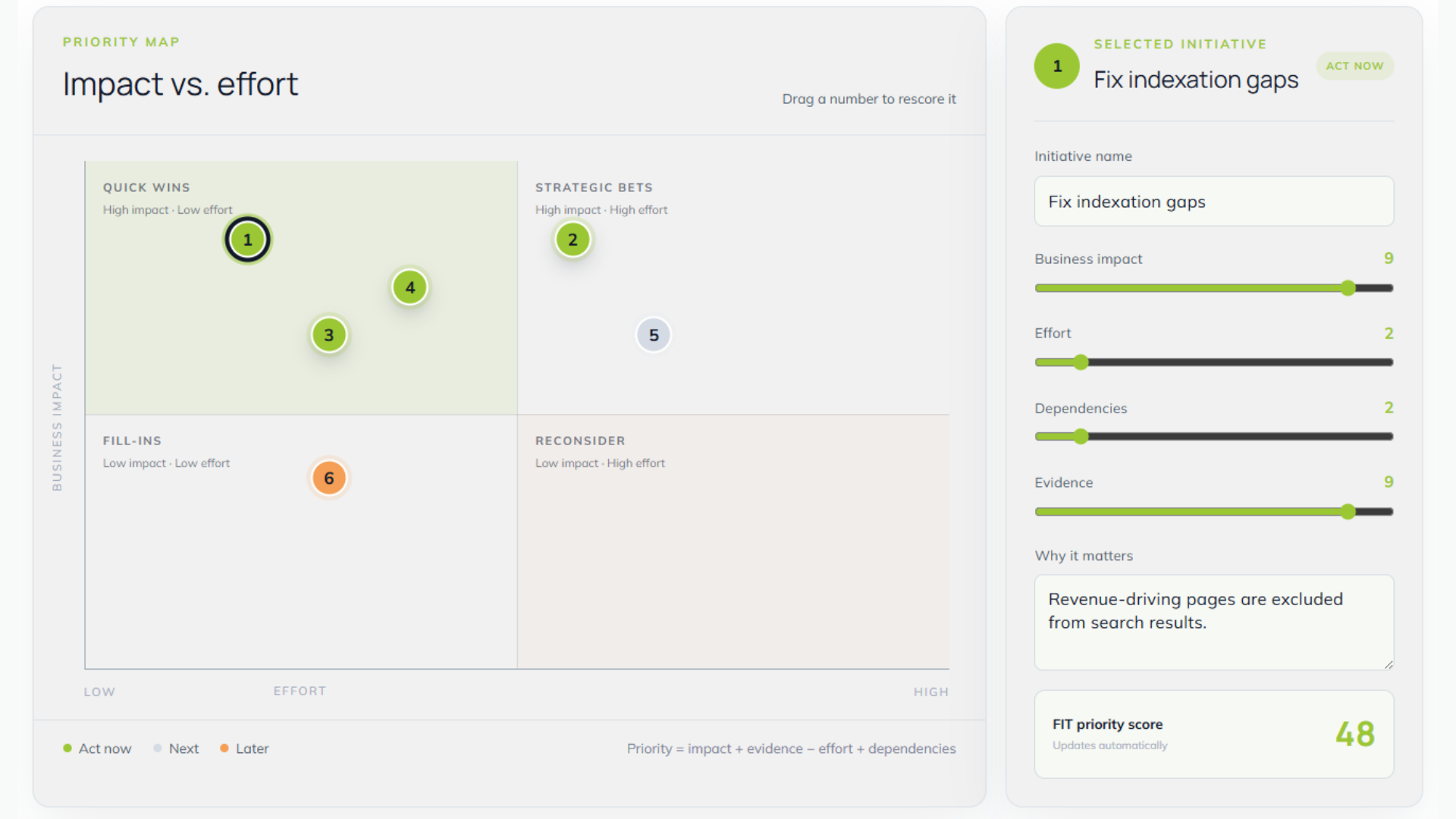
Our marketing prioritization framework, FIT stands for Foundational, Informational, and Transactional. A FIT analysis translates evidence into priorities and a ranked sequence of work. Every candidate initiative is scored against four factors:

The result is a clear understanding of what should happen first, what can happen concurrently, and what should wait until the necessary foundations are in place. It also surfaces the things nobody asked about: blockers, trust gaps, and dependencies that can cap the results of everything else.

FIT Analysis Priority Map, developed by Level343 LLC
Example output from the FIT Analysis Model

See how FIT changes the decision.

The interactive FIT Analysis prototype shows how the model weighs business impact, dependencies, effort, and evidence to change what gets prioritized. It’s a simplified example of the thinking behind FIT. Your actual strategy is built from your business objectives, data, constraints, and market conditions.

PRIORITIZE YOUR MARKETING ACTIVITIES

What happens now and in the future?

FIT produces two planning documents designed to work together. These phases run together. Your marketing roadmap might prioritize rewriting five high-performing service pages to lift click-through rates this quarter, while the longer marketing strategy begins the technical restructuring, content architecture, and authority building that make next year’s growth possible.


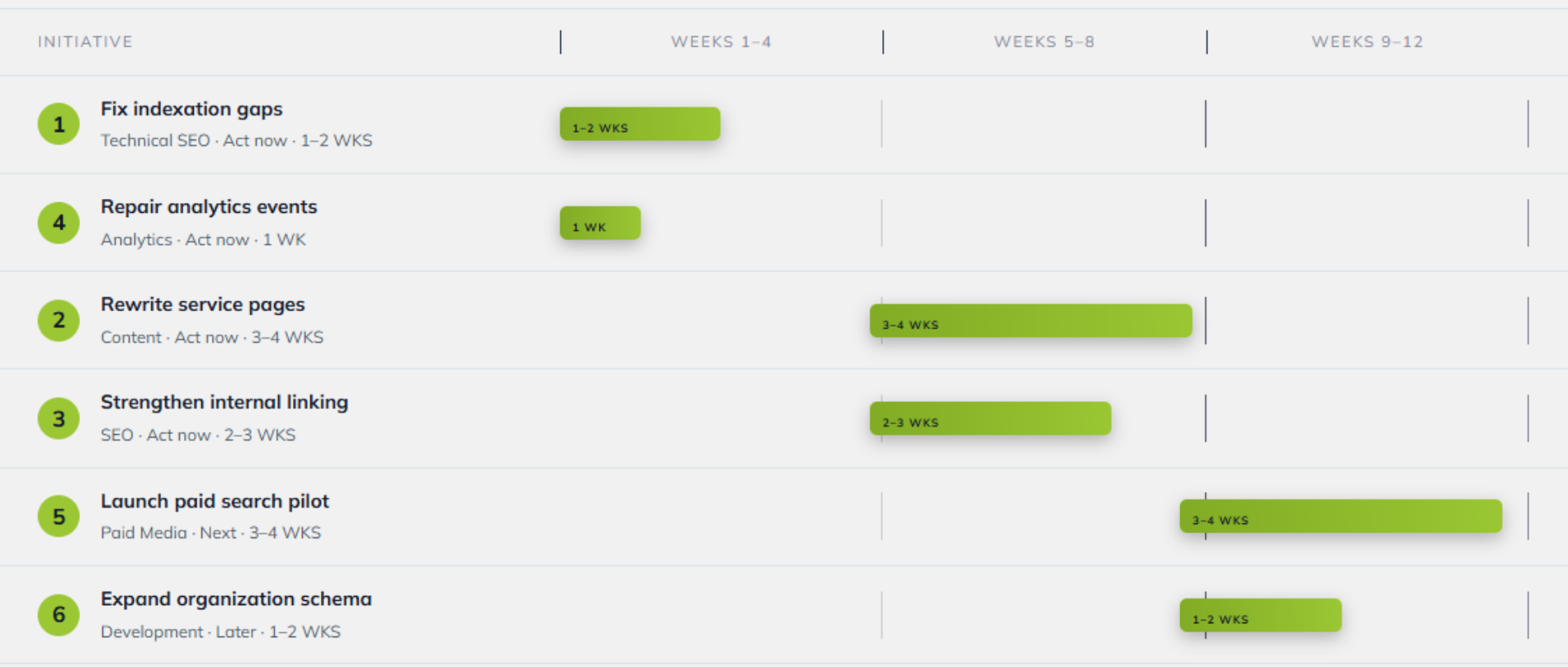
Sample 90-day roadmap

90-day roadmap
Example 90-day roadmap from a FIT analysis

90-Day Roadmap

Your marketing roadmap addresses immediate priorities. This is the highest-value work that can begin right away, which could be technical fixes, specific page targets, PPC, brand work, whatever the evidence points to. These initiatives are most likely to move your goals within a quarter.

Ongoing Strategy

Your marketing strategy sets the long-term direction. These are the larger initiatives that need planning, coordination, or foundations before they can start. Strategies are reviewed, compared to the benchmarks, and reset as needed as quarterly results come in. See a sample strategy.

DEFINE KPIS

How will we measure success?

KPIs are chosen based on your business goals and the specific goals of the roadmap, not from a standard reporting package. Some are business measures, some are marketing measures, and we’re explicit about which is which.

Increased Revenue

Qualified Leads

Streamlined Pipeline

Higher Conversion Rates

Cost Per Acquisition

Organic Traffic

Higher Rankings

03

DELIVER

Execute, measure, and adjust.

EXECUTION

Who does the work?

Our operating model is flexible, and the right one depends on your team’s capacity and what you want to build internally.

Most clients choose a blend of collaboration and teaching: we operate as an extension of the in-house team while building the team’s own understanding of what drives results.

IMPROVE

What changed, and what's next?

We measure progress against every level of the plan: business goals, roadmap goals, and strategy. When something works, we push harder on it. When results trend down, we review and pivot. Measurement isn’t a report at the end of a list of tasks. It’s a loop.


Improving your strategic results

BUSINESS OUTCOMES

What results does this produce?

Multi-location healthcare

A comprehensive audit found crawl and indexation blockers across several location pages.

The 90-day roadmap prioritized technical blockers and local page optimization. The parallel strategy included updating class pages for clarity and easier enrollment.

Results: +18% enrollments within the first year, +42% within two years

Ecommerce

The audit uncovered slow category pages and then low-quality product content.

The 90-day roadmap prioritized speed, category structure, and product content. The parallel strategy included revamping the navigation structure on the product pages to be more in line with the customer journey.

Results: +15% revenue within 120 days

Every recommendation, roadmap item, and KPI traces back to a stated business goal. You can see exactly how marketing contributes to the progress. Priorities shift as conditions change; the measure of success doesn’t.

That’s what optimizing for business outcomes means. Not just marketing metrics.

BEST FIT

Who do we work with?

We work best with organizations that have real decisions to make about where to spend limited resources.

Engagements start at $2,000 per month. Pricing depends on scope of work, site complexity, and how much of the execution we handle. 

The companion of "guess" is "risk."

Start with the evidence. 

You don’t have to guess which of several initiatives to move forward on. Learn how users and search engines understand your site, and which priorities to address now, in parallel, and in the future. 

Hello there! Please read to understand how we handle your privacy.

This website uses tracking cookies to help us understand how you use the site and improve upon your experience. We do not share any information collected – either personal or anonymous – with any other parties, with the exception of the reporting programs we use in conjunction with those cookies. By continuing to use this site, you agree to the use of these cookies. If you do not agree, please close the site.